

Understanding Ethereum Governance
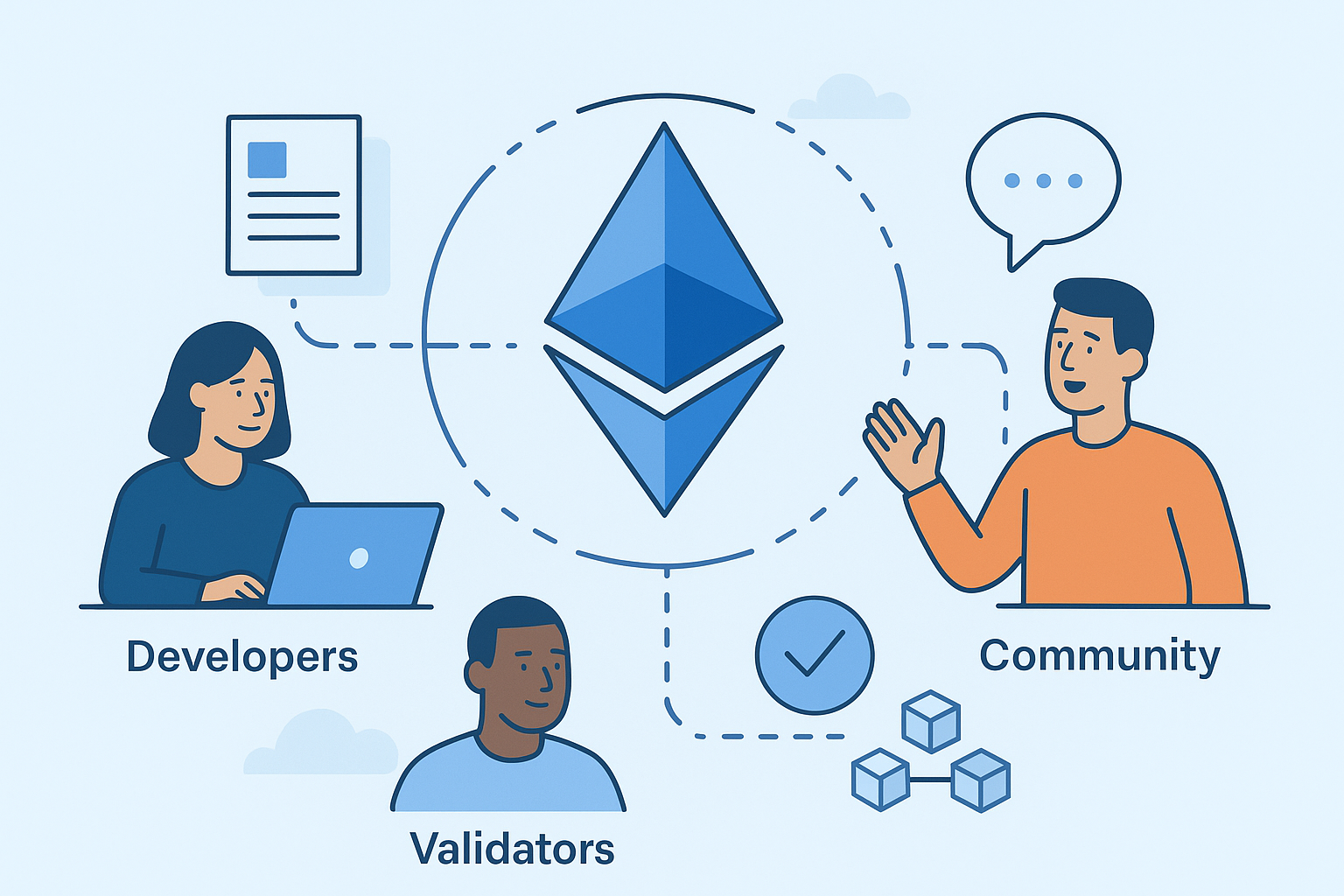
Ethereum is more than a blockchain—it’s a decentralized platform whose evolution relies heavily on its governance structure. Unlike centralized systems, Ethereum doesn’t have a single authority dictating its development. Instead, its growth is guided by a collaborative process involving developers, validators, and the wider community.
At the core of Ethereum’s governance are Ethereum Improvement Proposals (EIPs). These are formal documents outlining suggested changes, enhancements, or new features for the network. Each EIP is debated, reviewed, and refined before it can be implemented, ensuring that updates are transparent and thoroughly vetted.
The Role of Developers
Developers are the backbone of Ethereum’s evolution. They propose, review, and implement EIPs, bringing technical expertise and vision to the platform. Key developer groups, including the Ethereum Foundation and independent contributors, coordinate upgrades and ensure that changes maintain network security and scalability.
However, developers don’t have unilateral power. Their proposals must align with network consensus, meaning the community and validators ultimately weigh in on whether a change is adopted.
Validators and Their Influence
Validators, especially after Ethereum’s transition to Proof-of-Stake (PoS), play a critical role in network governance. By staking Ether (ETH), validators secure the network and validate transactions. Their consensus is essential for implementing protocol changes, making their support for or against specific EIPs a significant factor in shaping Ethereum’s future.
Validators act as both enforcers of the protocol and representatives of the community’s interests. In this sense, governance is partially decentralized: those who actively participate in network security have direct influence over its direction.
Community Participation
Ethereum governance isn’t limited to technical actors. The broader community—including ETH holders, decentralized application developers, and even users—participates through discussion forums, social media debates, and off-chain signaling mechanisms.
Community feedback can influence developer priorities, highlight potential risks, and ensure that proposed changes serve the broader ecosystem rather than a small subset of stakeholders. While this influence is less formal than validators or developers, it is no less crucial for maintaining transparency and accountability.
Voting, Consensus, and Future Directions
Unlike traditional corporate governance, Ethereum doesn’t rely on straightforward majority votes. Instead, network consensus emerges from a combination of developer proposals, validator participation, and community support. This multi-layered approach helps balance technical feasibility with the interests of diverse stakeholders.
Future Ethereum upgrades, such as improvements to scalability, privacy, and smart contract functionality, will continue to test the robustness of this governance model. As the ecosystem grows, understanding the interplay between developers, validators, and community members becomes increasingly essential.
Conclusion
Ethereum governance exemplifies the challenges and strengths of decentralized decision-making. No single entity dictates the network’s evolution; instead, it relies on a dynamic collaboration between developers, validators, and the community. This system ensures resilience, innovation, and decentralization, but it also requires active participation and informed decision-making from all stakeholders.
As Ethereum continues to evolve, the question remains: who really decides the network’s future? The answer lies in the balance of influence among all participants—developers, validators, and the community working together to shape one of the most transformative blockchain networks in the world.
